- calendar_today August 12, 2025
.
For 25 years, Washington and New Delhi proclaimed the blossoming of what was supposedly one of the most productive strategic partnerships in the post–Cold War order. It was a relationship built upon multiple convergences, not least Washington’s desire to integrate India into the global order as a recognized power and the shared goal of countering China’s meteoric rise in the Indo-Pacific region.
But years of defense and diplomatic cooperation now face one of their biggest challenges after the ties began to fray due to mutual distrust that has deepened over the imposition of tariffs on Indian imports, a broader energy trade with Russia, and a diplomatic drift toward China.
“Trust has just evaporated,” Evan Feigenbaum, South Asia director at the Carnegie Endowment for International Peace, told PassBlue about the relationship between Washington and New Delhi. “We’re in a situation in the U.S.-India relationship where the premises and assumptions of the last 25 years — that everybody worked very hard to build, including the president in his first term — have just come completely unraveled.”
The U.S. relationship with India has “gone off the rails” since U.S. President Donald Trump, as he called it, announced last month 25 percent tariffs on all Indian goods to push New Delhi to stop buying Russian oil despite Moscow’s ongoing war in Ukraine. Trump also plans to double the tariffs to 50 percent on August 27. Instead of having an impact on India’s buying decision, however, it looks as if New Delhi has taken the opportunity to push closer to Moscow — and even Beijing.
The Kremlin is reportedly considering a pipeline that would allow for the delivery of Russian natural gas to India through Iran. Last month, India’s national security adviser, Ajit Doval, traveled to Moscow. Foreign Minister Subrahmanyam Jaishankar held a “working level” meeting there on August 4 and was met by Foreign Minister Sergei Lavrov. On July 29, Chinese Foreign Minister Wang Yi wrapped up his visit to New Delhi after having previously visited Moscow on July 27.
Prime Minister Narendra Modi is expected to visit China for the first time in more than seven years, and Russian President Vladimir Putin is looking to welcome him to Moscow before the end of the year. While some of those moves have been argued by Indian officials as mere symbolism, analysts see more to them than that.
India’s reluctance to bend to the U.S. will has also affected domestic public opinion in New Delhi, Feigenbaum said, adding: “They’re signaling very clearly that they view that as interference in India’s foreign policy, and they are not going to put up with it.”
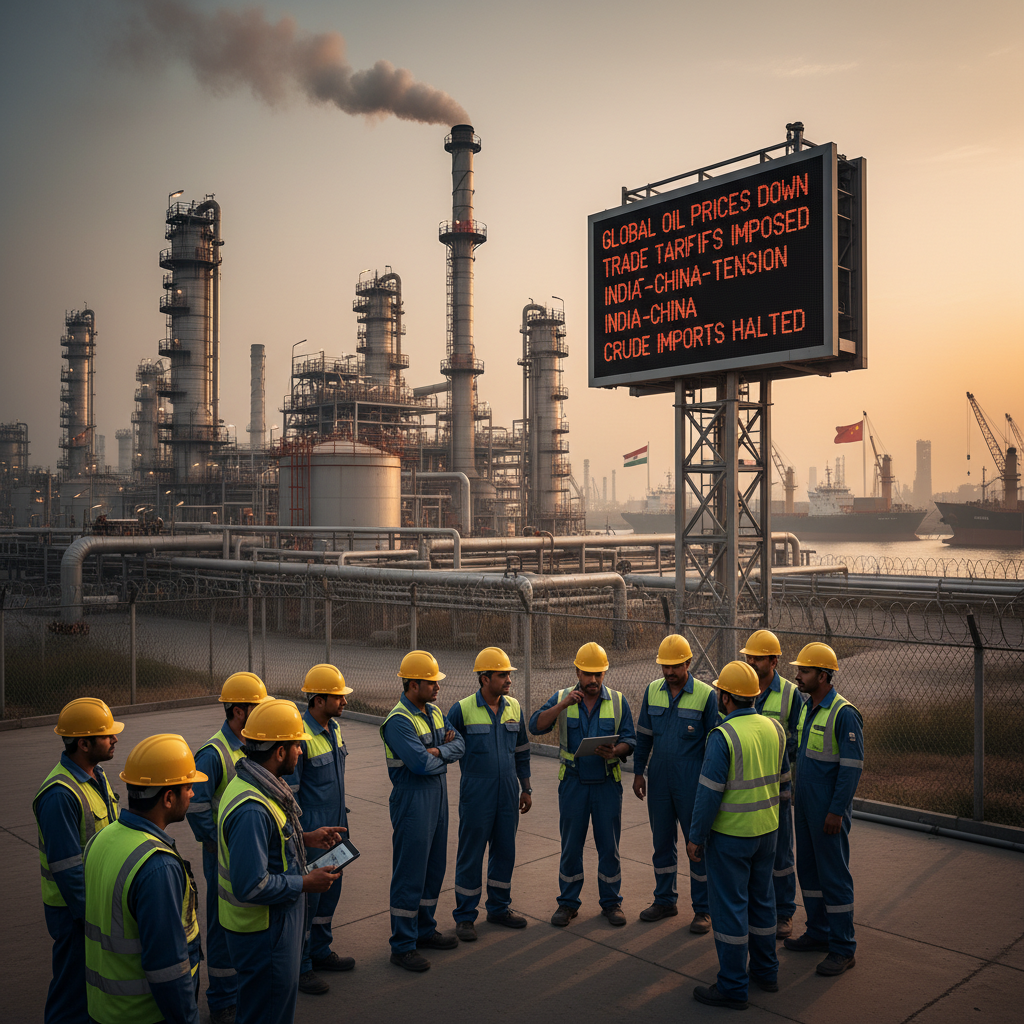
Indian state-run refiners, which had paused Russian oil purchases earlier this year after a brief bout of hesitancy over the war in Ukraine, have resumed the buying of oil from Moscow. The discounts that Moscow is offering — six to seven percent on the benchmark of Druzhba crude, according to Indian officials — have proven too hard to resist for New Delhi. As a result, Russia has overtaken Saudi Arabia to become India’s third-biggest oil supplier, after Iraq and the United States. Indian officials said this week that 35 percent of Indian oil imports now come from Russia, up from a fraction of 0.2 percent before Russia invaded Ukraine. Moscow is not turning down the offer either. Russia, through Deputy Prime Minister Denis Manturov, has indicated that it will continue to supply crude and oil products, thermal and coking coal, to India. Moscow also saw “potential for the export of Russian LNG.”
Shift in Policy Towards China and Russia
Michael Kugelman, a South Asia analyst at the Washington-based Wilson Center, also said that the decision to slap the tariffs on India to discourage its ongoing trade with Russia was “not the only factor that contributed to India shifting its posture and recalibrating its foreign policy.”
“We’ve seen indications for almost a year now of India wanting to ease tensions with China and strengthen relations with Beijing, mainly for economic reasons. But the Trump administration’s policies have made India want to move even more quickly,” he told PassBlue.
For Kugelman, some of the trips by top Indian officials to Moscow and Beijing “were meant for optics and performing” to signal to the West that India was not going to change its policy on Russian trade, while others were more substantial. Feigenbaum agreed. He explained to PassBlue: “There is a certain amount of performative politics that is going on. But India is going to double down on some aspects of its economic and defense relationship with Russia — and those parts are not performative.”
India had already started to diversify its defense purchases away from Russia, Kugelman said, before the Russian invasion of Ukraine began. In recent years, the Indian military has diversified purchases to include U.S., French, and Israeli equipment. However, since the war, energy purchases from Russia have expanded significantly. “So there was a sense from India that the U.S. can’t be trusted, whereas Russia can — because Russia is always going to be there for India no matter what,” he said.
By shifting India’s buying, Modi has been able to return home to support his vision of championing Indian sovereignty as the guardian of India’s farmers, small-business owners, and young workers. The political message of protecting the Indian working class is domestically popular. Kugelman noted that India had already given in on a number of issues to Washington, such as reducing tariffs and repatriating some of its workers, and could not afford to offer further concessions. “India needs to be careful about signaling further willingness to bend, so it puts its foot down on a trade deal, which is one reason why we didn’t see it,” he said.