
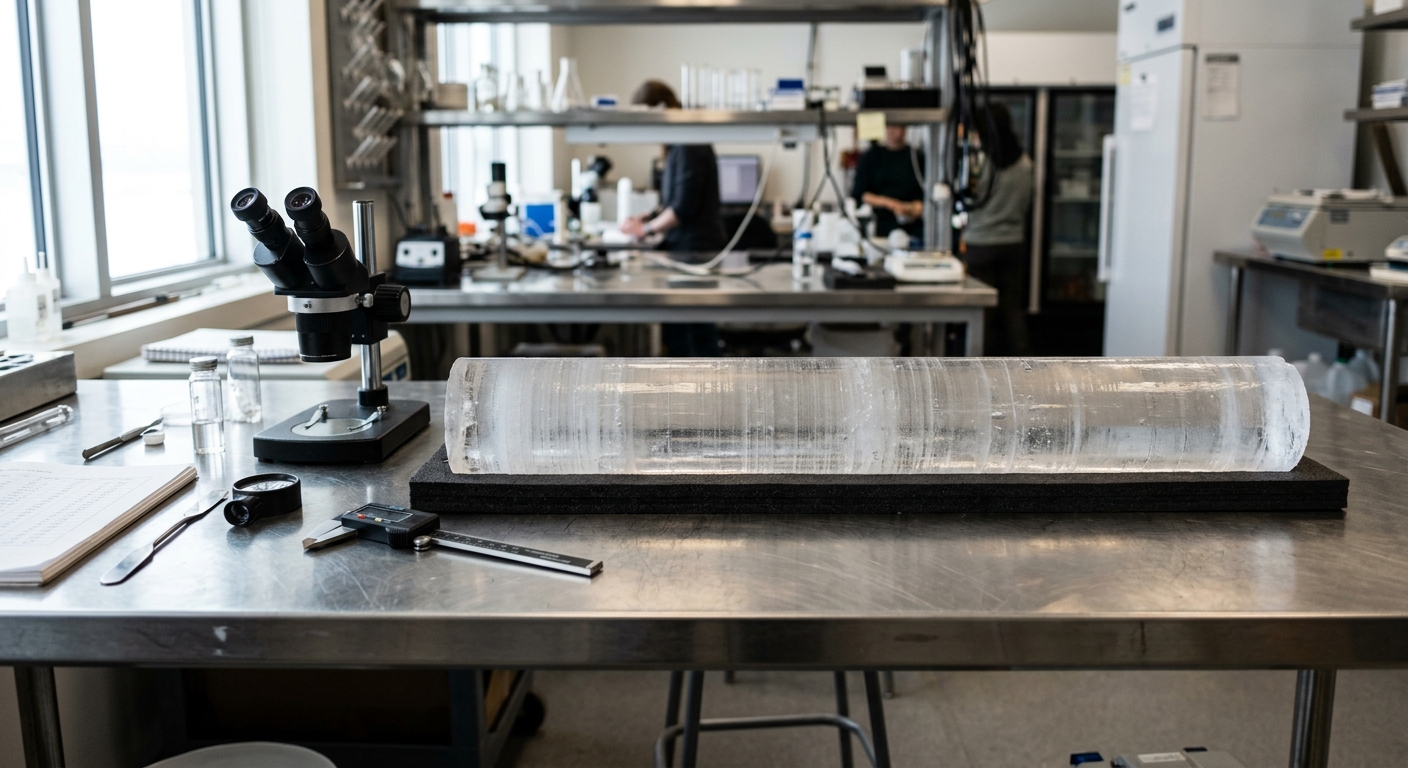
AI-generated illustration; not a photograph of the reported event.
- calendar_today October 9, 2026
Ancient Guliya Ice Core Extends Earth’s Glacial Record
An international team of scientists has discovered that ancient ice buried within the high-altitude Guliya ice cap in Northwestern Tibet preserves fragments dating back over 128,000 years. This makes the Guliya ice core the oldest ever recovered from the region and extends Earth’s glacial record by more than 100,000 years, according to a new study published in Science Advances.
Consistent Records Across Decades
The researchers compared two sets of ice cores collected from the Guliya Plateau, one drilled in 1992 and a second in 2015. Both samples revealed similar oxygen isotope patterns—key markers for interpreting climatic conditions—indicating that the environmental signals found in the ice have remained consistent and reproducible over time. "Reproducibility of the records within a given ice cap is extremely important," said Lonnie Thompson, lead author, professor of earth sciences, and senior research scientist at The Ohio State University. "If you get an identical record a quarter of a century later, it can tell you a lot about the behavior of the ice over time."
Advanced Radiometric Dating Techniques
To determine the age of the ice, the team used advanced radiometric dating techniques focusing on radioactive isotopes—beryllium and chlorine—which are reliable markers for large-scale environmental changes due to their long half-lives. These isotopes enabled the researchers to identify the Laschamp Geomagnetic Excursion, a reversal of Earth’s magnetic field that occurred more than 41,000 years ago and left distinct chemical traces in the ice.
Comparison with Nearby Records
By comparing the findings from the Guliya glacier with oxygen isotope records from cave deposits elsewhere on the Tibetan Plateau, the researchers estimate that the Guliya glacial record extends well beyond 128,000 years. "It’s a really critical finding, because outside of the polar regions, this is the only ice core we have from the mountaintops that go back that far," Thompson explained. Records from other high-altitude sites, such as Huascarán in the Andes, only extend back slightly more than 30,000 years.
Implications for Paleoclimate History
Ice cores serve as vital climate archives, preserving information about atmospheric conditions and environmental changes across millennia. However, accurately decoding these records relies on precise ice core dating and a robust understanding of each core's timescale. Prior work had suggested that Guliya’s record ended at the Mid-Holocene, roughly 12,000 years ago, but new evidence confirms that some of the glacier’s ice is much older.
"If we only had Holocene-era ice in Tibet, that would mean that the big ice sheets from the last ice age didn’t persist through the early Holocene," said Thompson. "But evidence shows that it did." The glacier’s unique topography likely helped preserve these ancient paleoclimate history records, offering important clues about when Earth’s intense glacial periods began and ended.
Broader Scientific Significance
Accurately dating ice from the Guliya ice core allows researchers to refine our timeline of major climate events, including the onset and retreat of ice ages. "When did ice start forming on the planet and what did those natural processes of loss look like? We need to know those things, and the only way you can really demonstrate it is with accurate time scales on these records," Thompson said. The team intends to use samples from the Guliya core for further research, exploring how other key climate markers may vary over these extended timescales.
Support and Collaboration
The research was supported by the U.S. National Science Foundation. Co-authors from The Ohio State University include Mary Davis and Ellen Mosley-Thompson. International contributions came from Juerg Beer (Swiss Federal Institute of Aquatic Science and Technology), Christof Vockenhuber and Marcus Christl (ETH Zurich), Tandong Yao (Chinese Academy of Sciences), and Ninglian Wang and Ling Fang (Northwest University in China).
Looking Forward
The discovery of ancient glacial ice on the Tibetan Plateau highlights the importance of climate archives beyond the polar regions. "The big picture is that our results tell a very consistent story," Thompson said. "If you get the science right, it’s consistent. It’s our understanding of what it’s trying to tell us that has to catch up." The Guliya ice core’s record is set to play a critical role in unraveling Earth’s climate past and informing the future of climate science research.
Source: news.osu.edu.