
- calendar_today August 20, 2025
.
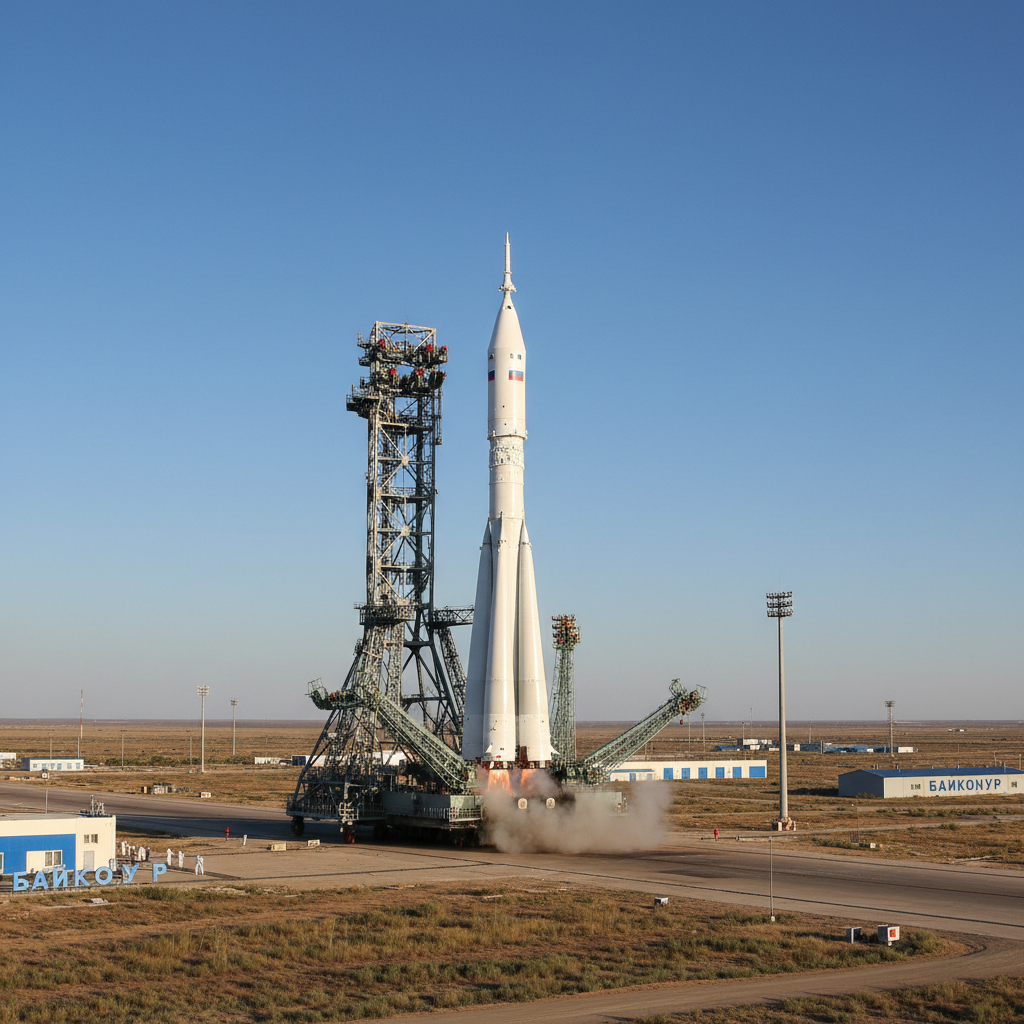
Russia will launch its next-generation rocket Soyuz-5 for the first time before the end of 2023. Dmitry Bakanov, head of Roscosmos, confirmed the plans in an interview with the state media service TASS.
“Yes, we are planning for December,” Bakanov said. “Everything is in place.”
If the flight proceeds, it will occur from the Baikonur cosmodrome in Kazakhstan. Soyuz-5 will be making its debut after more than a decade of work. Roscosmos plans several tests, but officials say that the vehicle will not be ready for full service until 2028 at the earliest.
Inside the Rocket
Soyuz-5 is also known by the name Irtysh, after a Siberian river. The rocket design is not especially new. In fact, it leans heavily on concepts from the Soviet space program.
The development effort dates back to 2016. The new rocket recycles the basic design but has moved all manufacturing to Russia.
The main change is a point of considerable pride for Moscow. Russia imported rocket parts from Ukraine for years. One major area of dependence was the Zenit-2 launch vehicle.
Zenit was a Soviet-era design that dated back to the 1980s. The Yuzhnoye Design Bureau of Dnipro, Ukraine, developed it. Ukraine produced the first and second stages of the rocket. Zenit flew for decades, carrying out a number of missions well into the 2010s.
The rocket had one big tie to Russia—the main engine. That was the RD-171 from the Russian company NPO Energomash. It had kerosene and liquid oxygen for fuel, and could produce a staggering amount of thrust. (Remember RD-170? This was its waterborne sibling.)
The two countries cooperated on Zenit even after the fall of the Soviet Union. But the partnership ended after Russia invaded Ukraine in 2022. In late 2023, the Russian military even struck the factory in Ukraine where Zenit rockets were assembled.
Essentially, Soyuz-5 is a Zenit that is made in Russia instead of Ukraine. The engine, fuel tanks, and upper stage are all slightly larger than in the Soviet-era rocket. The end result is a bigger vehicle with roughly the same capabilities but without foreign components.
Performance Specs
Soyuz-5 can carry a payload of 17 metric tons into low-Earth orbit. That is considered medium-lift capability. By increasing fuel capacity, the new rocket is able to deliver more weight than the Zenit-2.
The showpiece of Soyuz-5 is the RD-171MV engine. It is the successor to the RD-171 used in the Zenit. Like that earlier engine, it uses kerosene and liquid oxygen propellants. The technology is a descendant of the Soviet Energia rocket and the Buran space shuttle that it once launched.
The RD-171MV engine has no Ukrainian components, unlike the earlier version. It is rated to produce 760 tons of thrust in a vacuum. To put that in context, a single Space Shuttle main engine put out less than 250 tons of thrust.
The RD-171MV is widely considered the most powerful liquid-fueled rocket engine currently in operation.
Soyuz-5 is not designed to be reusable. Almost all of its competitors, including SpaceX’s Falcon 9, are reusable in some way. The rocket goes back to the drawing board after every launch.
That may put Soyuz-5 at a disadvantage in the years to come. The commercial space launch market has been reshaped by reusable designs.
Domestic Drive
Roscosmos has not been shy about its intentions for Soyuz-5. In many ways, it is a stopgap measure to wean Russia off of its imports.
Russian funding for spaceflight has suffered over the last few years. Resources are being funneled to the war in Ukraine, and sanctions have made it hard to do business with the West. Despite those headwinds, the Soyuz-5 development is remarkably close to launch.
Russia is seen as using the vehicle as an alternative to the Zenit. Roscosmos has also signaled its willingness to replace the aging Proton-M with Soyuz-5 in the near term.
The real future, in Moscow’s mind, will be the Soyuz-7. The development of that rocket is also known as the Amur project. It, too, is a descendant of Soviet-era designs but promises more modern features. The Amur has been in the works for a while but keeps getting pushed back.
In many ways, it is a much more exciting design than Soyuz-5. It is also much more ambitious. The Soyuz-7 is supposed to use reusable first stage and methane-fueled engines.
The problem is that the first flight of Amur will not happen until well after the first flight of Soyuz-5. Amur’s maiden flight is not expected until 2030 at the earliest. That is more than seven years away. In the meantime, Soyuz-5 is a placeholder at best.
Commercial Market
It is not clear if Soyuz-5 will even find customers beyond Russian borders. The international launch market is now the domain of SpaceX. Chinese launches have also become more common and increasingly competitive.
Moscow still flies the Soyuz-2 for crewed missions and Angara rockets for heavy payloads. But those launch vehicles have not found a market beyond Russian borders, either. For Soyuz-5 to change that calculus, it would have to be both reliable and more price-competitive.
On the one hand, Russia has established a niche in crewed spaceflight. SpaceX, on the other hand, tends to do far better in the smallsat and microsat launches that drive much of the commercial launch market.
In Conclusion
All eyes will be on Baikonur when Soyuz-5 flies. If the December flight goes well, it would prove Russia can still produce modern space technology in spite of sanctions and budget cuts.
Whether Soyuz-5 represents a leap forward in space technology is up for debate. For Roscosmos, however, it is at least an assertion of independence and a way to keep the lights on through the 2030s.