- calendar_today August 17, 2025
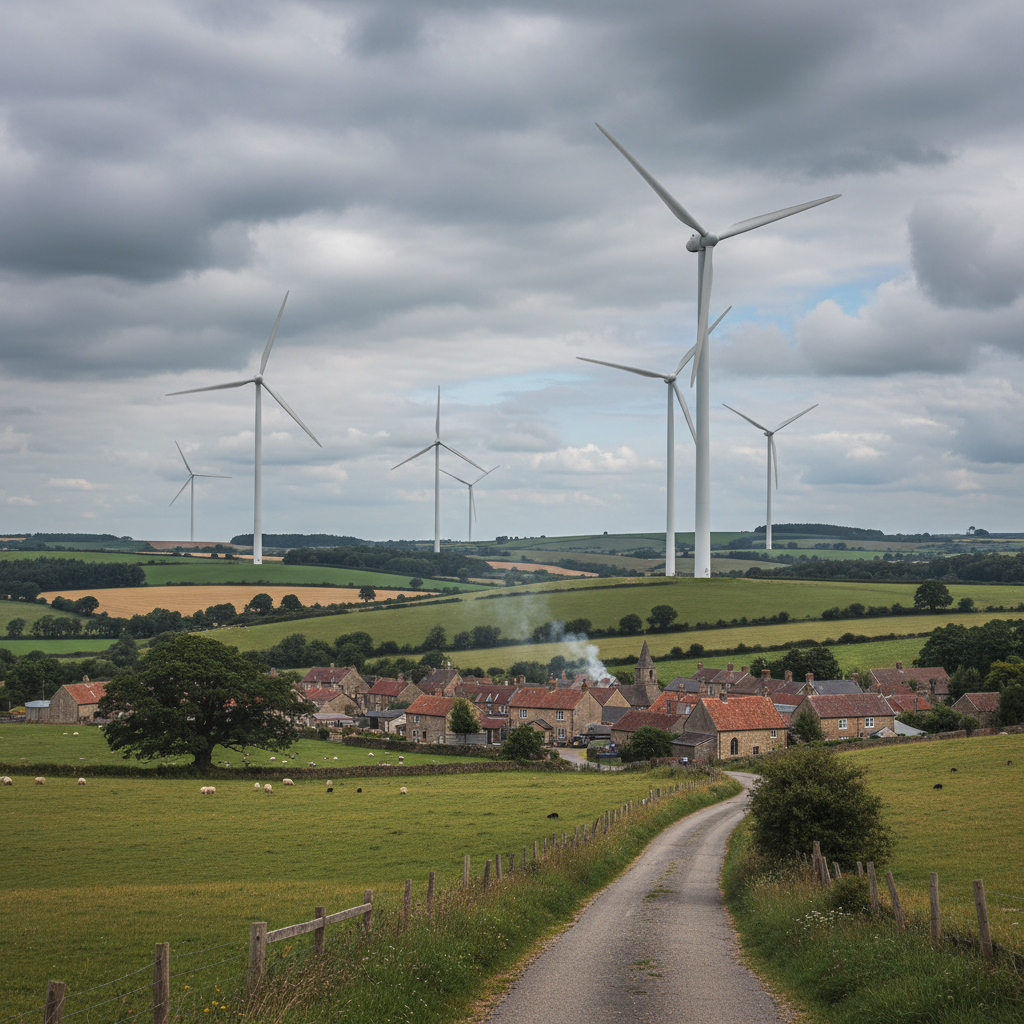
U.S. President Donald Trump was giving a press conference on a European Union trade deal when he started talking about wind turbines. “You know what they do, right?” he asked, according to a White House pool report. “They take your quiet village, drive your whales loco, kill your birds, hurt your child’s health.”
He was in his familiar anti-science, anti-renewable energy groove. In fact, he called the turbines “windmills,” a term he and others on the political right have increasingly used to discredit the technology.
The theatrical flourish was vintage Trump, but the sentiment isn’t a random soundbite. It’s part of a much broader, more troubling global pattern. Conspiracy theories, deeply held fears, and coordinated misinformation campaigns about renewable energy are as old as the movement itself.
Academic research shows that once these views are planted in a person’s belief system, they are difficult to dislodge with fact-checking or peer-reviewed science. They are also very much in the way of governments, businesses, and institutions that want to speed the world’s clean energy transition.
Roots and Rise of Anti-Wind Conspiracy Theories
Climate scientists have been warning since the 1950s that CO2 emissions could alter the world in major and relatively imminent ways. But in the early days of renewables advocacy, there was also a sense that the technology could directly challenge the dominance of fossil fuel companies.
Fast forward to the present, and pop culture contains countless references to this idea. In the old days of The Simpsons, Springfield’s power tycoon, Mr. Burns, built a tower to block out the sun, so that the town’s citizens had no choice but to buy his nuclear power. The cartoon was, of course, a satirical exaggeration—but in it there was a kernel of truth. Fossil fuel companies could, and would, lobby and litigate to delay a renewables transition.
In fact, they did. As part of his 2004 election campaign, then–Australian Prime Minister John Howard formed a coalition of fossil fuel industry executives he called the Low Emissions Technology Advisory Group (LETAG). The stated aim of the coalition was to “slow the growth of renewable energy,” according to official government documents.
Wind farms, in particular, have attracted intense conspiracy theories. Unlike coal mines, oil fields, and nuclear plants, which are mostly out of sight and out of mind, wind turbines are hard to hide. They’re usually on ridgelines or open plains, where they loom over the surrounding landscape. They’re also easy targets for conspiracy theorists. Accusations of a “wind turbine syndrome,” a “non-disease” according to medical experts, dogged the industry for years.
Winter and his colleagues have also documented the anti-wind conspiracy theory ecosystem. After surveying people across Germany about wind farms, they concluded that demographics such as age, gender, or education level were much less predictive of opposition than belief in conspiracy theories. More recently, researchers working in the U.S., U.K., and Australia came to the same conclusion. They found that people who were predisposed to believe in conspiracy theories—about climate change, or health care, or energy security—were also more likely to believe in the wind conspiracy theories.
The Importance of Identity and Worldview
Opposition to wind farms is rarely a matter of facts or demographics, but of worldview. As Winter and his co-authors put it, wind farm opposition is “rooted in people’s worldviews, not in lack of information.”
It’s no use trying to convince anti-wind conspiracy theorists that their energy won’t be taken away, or that the turbines don’t poison groundwater or cause mass blackouts. Wind turbines won’t make their skin sag, as one anonymous survey respondent believed, nor will they cut off energy in revenge for buying an electric vehicle, as another respondent in the same study believed.
This is where conspiracy theories help. By their very nature, conspiracies allow the believer to externalize blame. Wind turbines are seen not just as a technical or economic issue, but as a deliberate attack on the individual, the community, and the nation.
In some ways, this should not be surprising. Fossil fuels have, for more than a century, powered an age of immense prosperity. To admit that fossil fuel use has environmental downsides can thus be seen as a kind of loss or humiliation for those who benefited from this wealth. This refusal to “cope with negative outcomes and costs” is, some scholars say, an “anti-reflexivity” posture.
Trump and his MAGA fans certainly demonstrate elements of anti-reflexivity. His evocation of coal, oil, and gas is an explicit nod to past economic success; his othering of scientists, “prophets of doom,” and wind turbine conspiracy theorists is a refusal to “cope with negative outcomes and costs.”
Wind farms have also become an issue of identity politics for some. The “manosphere,” for example, is a notorious online community in which anxiety over climate change is stoked by the suggestion that being concerned about it is not masculine. For some white heterosexual men of the baby boomer generation, wind turbines may represent an especially disorienting loss of power in a world that once felt stable and secure.
In short, Trump’s attacks on wind turbines might not stand up to scientific scrutiny, but they resonate with a certain worldview. For those who agree with him that wind turbines are a symbol of the liberal elite’s disdain for “real Americans,” facts and figures are not much use.