
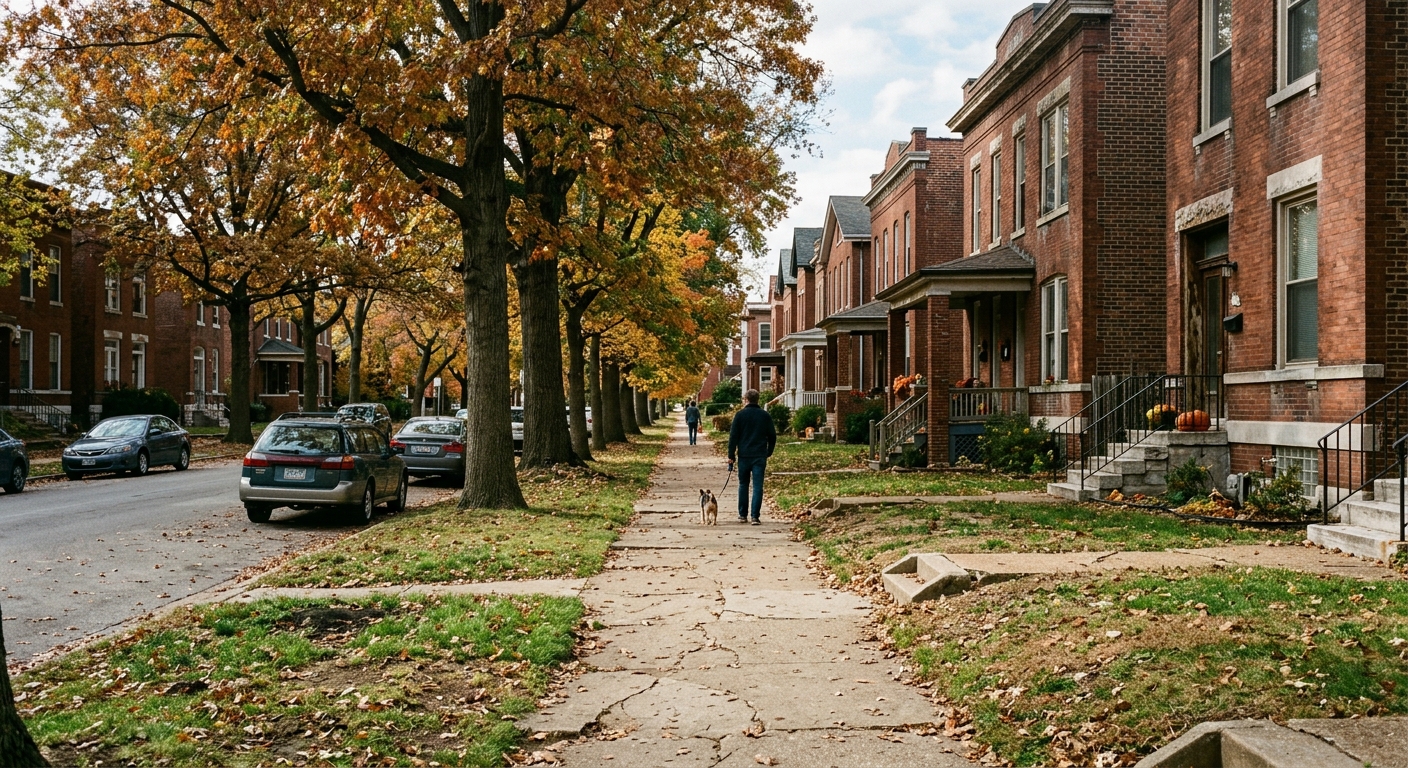
AI-generated illustration; not a photograph of the reported event.
- calendar_today October 14, 2026
New Research Highlights Complex Links Between Green Space and Firearm Homicides
A recent study by The Ohio State University reveals that urban green space may play a significant role in gun violence prevention—but the effects depend heavily on local neighborhood factors. While greenery such as parks, trees, and landscaped streets can improve community health and reduce violence, not all neighborhoods experience these benefits equally.
Utilizing Google Street View and Machine Learning for Analysis
The study, published in Urban Forestry & Urban Greening, investigated gun violence in Cook County, Illinois, a region that reported the highest number of homicides in the U.S. in 2022. Led by Associate Professor Gia Barboza-Salerno, the research team used Google Street View images and machine learning tools to measure the actual visible greenery at the locations of 899 firearm homicides and 2,256 natural deaths reported in 2023. This approach provided a street-level, pedestrian perspective on environmental factors present at each scene.
Neighborhood Disadvantage Affects the Protective Value of Green Space
The findings suggest that not all green spaces are equally effective in preventing firearm homicides. In less disadvantaged neighborhoods, increased greenery, tree canopy, and green space along walkable streets were associated with a lower likelihood of a death being a firearm-related homicide. In contrast, within highly disadvantaged neighborhoods—characterized by poverty, economic inequality, and housing challenges—proximity to parks sometimes corresponded to a higher risk of firearm homicide.
According to the study, this paradox may result from deeper issues of social deprivation overriding the protective benefits of green space, demonstrating the critical interplay between environmental quality and social inequality.
Implications for Urban Planning and Public Health
The research highlights the need to consider local context and social conditions when designing gun violence prevention strategies that involve urban green space. Barboza-Salerno notes, “It’s not as simple as planting a tree and thinking that alone will solve it. Even though we know urban greenery is a great prevention measure for a lot of reasons, we don’t understand how or whether there’s an interaction between where this greenery is—the local context in which the greenery sits—and a subsequent reduction in violence.”
Well-maintained parks in resource-rich neighborhoods can have a beautification effect, foster positive community interactions, and encourage residents to look out for one another. Conversely, in communities facing economic disinvestment, poorly maintained parks may not serve as effective violence prevention tools and can even be perceived as neglected or unsafe spaces.
The Role of Broader Community Initiatives
Beyond environmental interventions, the study advocates for comprehensive approaches to community safety. Barboza-Salerno’s previous work with the Dudley Street Neighborhood Initiative in Boston demonstrates that engaging youth in park revitalization not only improves local parks but also fosters skill development and changes public perceptions. Parks that are lively and cared for can offer safe places for interaction and recreation, becoming one piece of a broader, multi-faceted effort to address violence and build stronger communities.
Study Limitations and Future Perspectives
The research team emphasizes that their analysis looked at environmental factors present at the locations of the deaths, rather than the full life context of the victims. Co-author Taylor Harrington explains, “It doesn’t encapsulate their whole lived experience or exposure throughout life up until that point.”
Joining Barboza-Salerno and Harrington as co-authors are Balaji Ramesh and Jeffrey Wing of The Ohio State University College of Public Health. The study underscores the importance of strategic urban planning that considers both environmental and social factors to effectively address community safety and gun violence prevention.
Source: news.osu.edu.