- calendar_today August 15, 2025
Species: The B-Movie That Almost Wasn’t
The Hollywood world lost actor Michael Madsen earlier this month. As his many contributions to film are still being processed, one of the more overlooked roles in Madsen’s oeuvre is as a black ops mercenary on the trail of a half-human, half-alien hybrid in the 1995 movie Species. While the film, now turning 30, has received some renewed critical interest as of late, few mention one of Madsen’s more eccentric turns in a film career otherwise full of them.
Species, which is set in the present day, is a story about two transmissions from outer space that are decoded by the U.S. government. One includes a blueprint for a new energy source that the military is eager to get its hands on; the other includes instructions on how to splice human DNA with alien DNA. Predictably, the government gives the experiment a go.
The project is led by Dr. Xavier Fitch (Ben Kingsley), who develops a hybrid out of an “infertile human female and some extra-terrestrial DNA.” The result is Sil, who in her formative years is played by Michelle Williams. The experiment aimed to produce a controllable, benign organism for testing. Instead, the military created a monster.
Sil matures at an accelerated rate and, within the space of three months, has the appearance and biological markers of a 12-year-old human girl. But something doesn’t add up: Sil has frequent and violent nightmares, and she begins to display aggressive behavior that suggests she might be less “controllable” than first believed. When Fitch elects to kill Sil by pumping cyanide into her air supply, she manages to escape. And so the chase begins.
Fitch and others (played by Madsen, Marg Helgenberger, Alfred Molina, and Forest Whitaker) set out to track Sil down before she can mate and reproduce. The search takes the team across the country and finally to Los Angeles, where Sil, now in her adult form and played by Natasha Henstridge, begins to hunt and kill to find a suitable mate.
Henstridge’s Sil is cold, ruthless, and calculating; she also, frankly, is a lot of fun to watch. Henstridge has the grace of a cat but also moves with the quickness and agility of a panther. As it turns out, the human half of her genetic makeup is dwarfed by her alien side, which is intelligent, adaptable, and guided by a primal, almost animalistic instinct. As a result, bodies begin to pile up: a train tramp, a nightclub attendee, and eventually a partner, all fall prey to Sil’s methodical bloodlust.
In the meantime, Fitch, Helgenberger’s Dr. Laura Baker (a molecular biologist), Molina’s Dr. Stephen Arden (an anthropologist), and Whitaker’s Dan Smithson (a sensitive empath who can “feel” Sil’s emotions) track her movements across the U.S. They are aided by Lennox (Madsen), a mercenary who cuts through government red tape with cold efficiency. Eventually, the team locates Sil in Los Angeles and engages in a lethal game of cat-and-mouse with a creature that is as beautiful as she is deadly.
A Monster Designed to Seduce (And Kill)
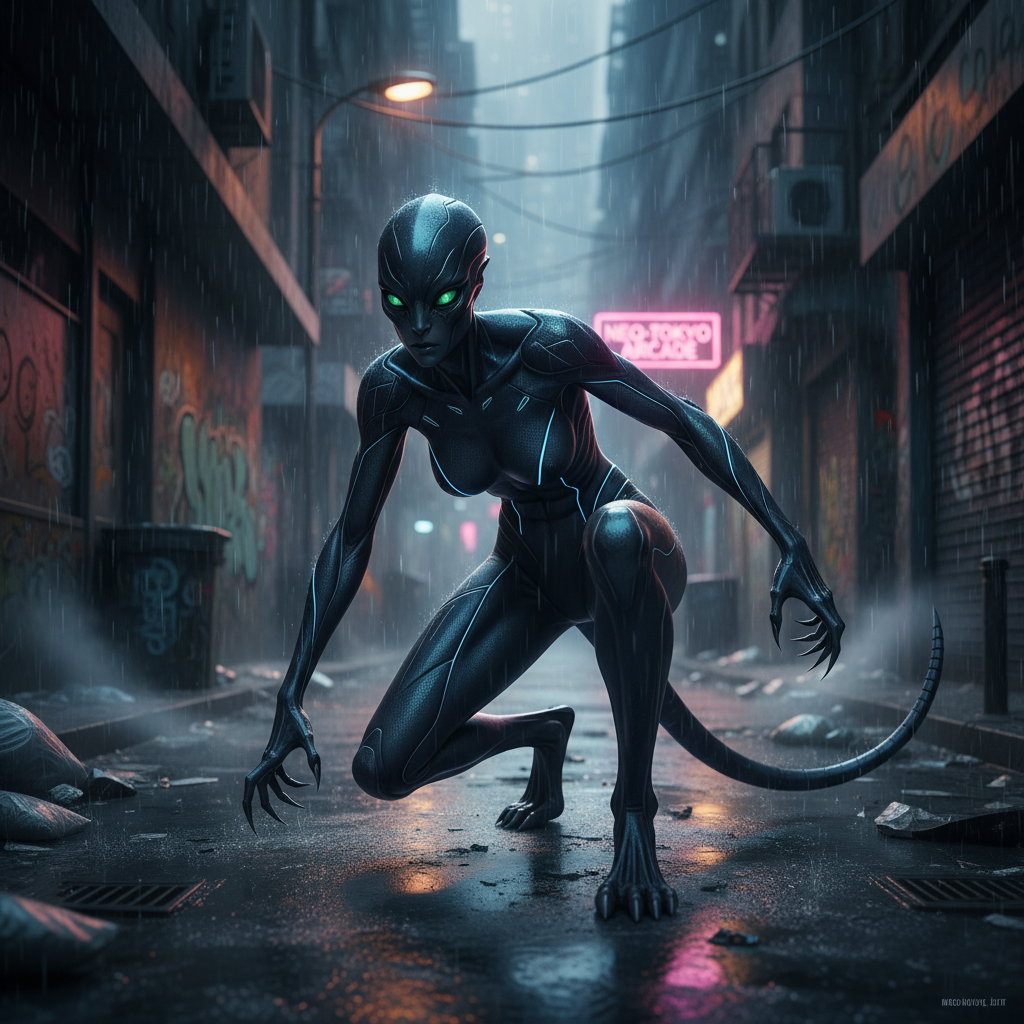
Species would not be a memorable monster movie without a memorable monster. The film’s producers tapped legendary surrealist artist H.R. Giger to design Sil. Giger was a Swiss painter, sculptor, and set designer, most well known for his work in the original Alien film; indeed, for Species, he helped to design Sil with Alien’s xenomorph in mind.
Giger’s vision was to create “an aesthetic warrior, also sensual and deadly.” He managed to bring this vision to life. Sil’s final design was for her to have translucent skin with a body that Giger likened to “a glass body but with carbon inside.” Giger initially wanted to incorporate five distinct stages of alien DNA development into Sil’s physical appearance, but production constraints prevented him from doing so.
The Alien-like creature design helped to make Species a commercial success, but Giger did not share the same sentiment. Giger was not fond of the finished film; he thought Species was an Alien ripoff and found many visual elements in the finished film were too similar to those in the 1979 sci-fi masterpiece. Sil’s punching tongue was an Alien homage, and her infamous birth scene at the film’s climax was a direct copy of Alien’s chestburster sequence. Giger lobbied to have Sil killed by a bullet to the head rather than burned to death with flame throwers, which he said bore more of a similarity to Alien 3 and Terminator 2.
Species Was a Mess—But It Worked Anyway
Species is, in many ways, a messy film. The dialogue is sometimes stilted and laughably bad, and most of the characters are flat and uninteresting. The ethics of genetic manipulation are not explored in any meaningful way, and the otherworldliness of Sil’s alien side is touched on only in service of telling the “monster stalks and kills” story.
Kingsley’s villain is an amoral boogeyman; Whitaker’s sensitive is a background player, whose only job is to intone the obvious, such as when Sil is being “seductive and dangerous at the same time.” The film’s themes and storytelling aspirations—contact with extra-terrestrial life, bioethics, maternal instinct—are window-dressing at best, raising more questions than they can satisfactorily answer. In a movie that, according to screenwriter David E. Kelley, was inspired by an article from Arthur C. Clarke that speculated that alien life would never visit Earth because faster-than-light speed travel is physically impossible, Kelley played with an idea that could potentially explain alien contact.
What if, Kelley wondered, extraterrestrials first contacted Earth with a set of organic blueprints rather than through a starship or radio transmission? What if a species were created that was as human as they were alien, both in design and in ability to assimilate with other human beings? Kelley’s result was a film that is a Frankenstein monster: parts of it are a quasi-intellectual, pulpy riff on classic sci-fi, and other parts are a gleefully exploitative and pulpy horror film.
Species Can’t Hold a Candle to Alien or The Terminator. It Found Its Niche Anyway.
For a film that opened with one of the most famous opening credits sequences of the 1990s and featured one of H.R. Giger’s most Alien-like designs ever (if the artist himself is to be believed), Species never quite took off as a critical darling. But it does have a cult following for good reason.
In part, the film’s appeal lies in the weird, fleeting sense that it’s attempting to touch on something intellectually provocative, while also offering a slasher’s worth of carnage for the ultra-violent inclined. In any case, as a time capsule of what 1990s-style science fiction looked like in an age of style before substance was king, Species will, at the very least, stand out as an entertaining (if fatally flawed) one-off from a time when a once-in-a-generation actor like Michael Madsen could step into an unforgettable role at the drop of a hat.