
- calendar_today August 16, 2025
.
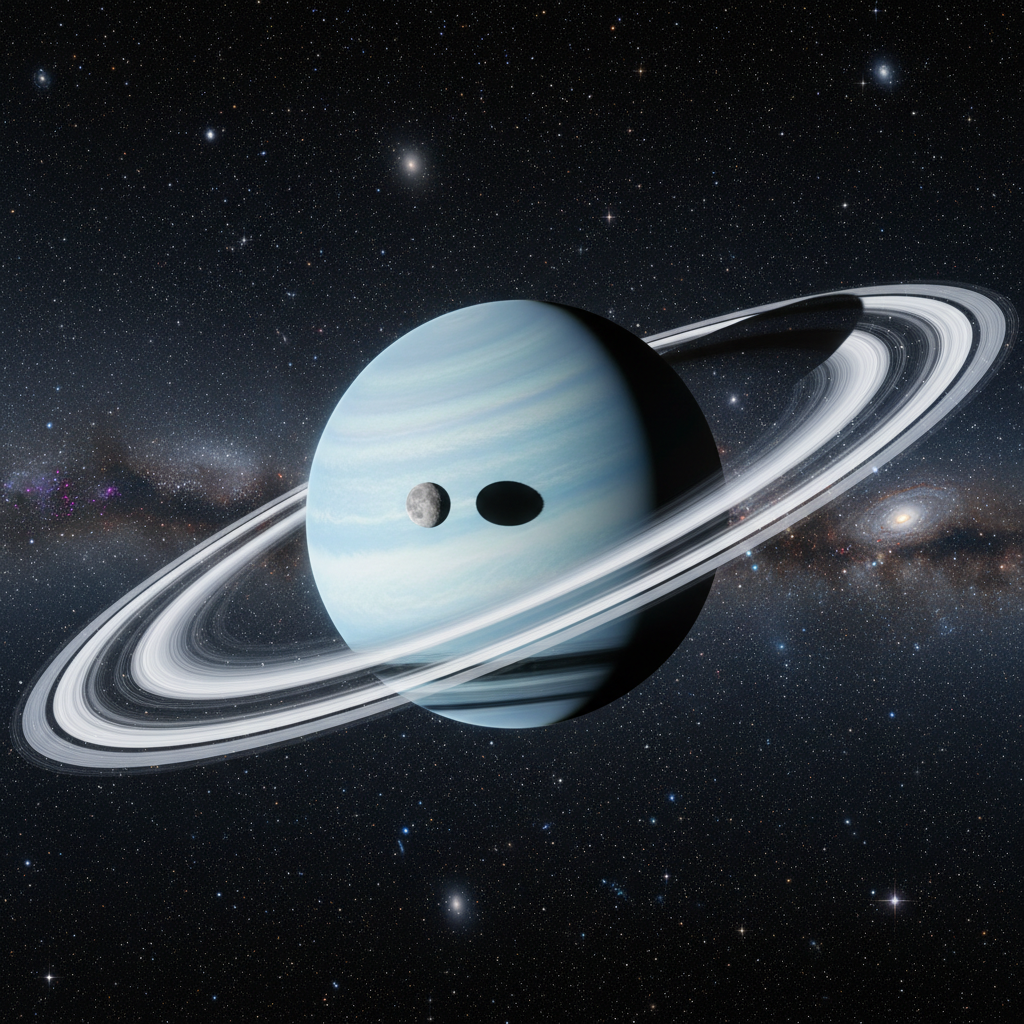
The James Webb Space Telescope has detected a hidden new moon orbiting Uranus. One of nine known planets in our solar system, Uranus has 28 confirmed moons and one newly discovered natural satellite seen for the first time by Webb.
Observations reveal a faint object in the glare of the ice giant’s rings that likely evaded detection by previous telescopes and spacecraft. An international team of scientists announced the discovery on March 12.
“Uranus already has a complex system, and with this new moon, we’re filling in the puzzle pieces,” said lead author Maryame El Moutamid of the Southwest Research Institute’s Solar System Science and Exploration Division in Boulder, Colorado. A principal investigator on a Webb program to study Uranus’ rings and inner moons, El Moutamid, noted that the discovery is a testament to how much Webb can see compared to previous missions.
Spotting a New Small Satellite
The small body, known provisionally as S/2025 U1, was spotted in the system on Feb. 2 by Webb’s Near-Infrared Camera during a series of long-exposure images, each lasting 40 minutes. At just 6 miles (10 kilometers) in diameter, it is one of the smallest natural satellites ever discovered around Uranus. The new moon is so faint and Uranus’s rings are so bright that it was probably missed by previous spacecraft and telescopes. Even NASA’s Voyager 2 spacecraft, which flew past the ice giant 39 years ago this month, likely overlooked it.
“This is a small moon but a significant discovery,” El Moutamid said. “Not only does it add to Uranus’ collection of known moons, it shows what Webb can see in a system where previous telescopes and spacecraft were blind. Webb will help astronomers understand this moon, and the rest of the Uranus system, in new detail.”
S/2025 U1 is located about 35,000 miles (56,000 kilometers) from Uranus’ center. It orbits nearly circularly and nearly equatorially, right between the known moons Ophelia, just outside the main ring system, and Bianca. If the new moon’s orbit is similar to where it formed, then it likely originated in the vicinity of its present location.
It took astronomers time to confirm that the small, fast-moving, dark object was a moon because of its proximity to the glare of Uranus and its rings. This is where Webb’s sensitivity to faint infrared light comes in. The telescope’s recent observations of Uranus have allowed glimpses of the planet’s rings, weather, and atmosphere. The discovery of this new moon is in keeping with that record.
Solving the Mystery of Uranus’ Rings and Moons
The detection of this new moon, along with much larger ones, is providing clues about the history of Uranus’s ring system. El Moutamid said astronomers think that this moon and part of Uranus’s rings could have a common origin. The new moon could be a fragment from the same collision event as a section of the ring.
“The discovery raises questions about how many more small moons remain hidden around Uranus and how they interact with its rings,” El Moutamid said. The largest five moons of Uranus are Miranda, Ariel, Umbriel, Titania, and Oberon. The new body is one of 13 known small moons in the inner system, while no other planet has as many small inner moons packed so close together. This is a mystery to astronomers. The satellites are so close together that their orbits would appear to cross. Somehow, they remain in orbit and are even thought to shepherd Uranus’ narrow rings.
“This is a very exciting discovery,” said Scott Sheppard, an astronomer at the Carnegie Institution for Science who co-discovered a new Uranus moon in 2024 but was not involved in the new research. “The thing that makes it especially interesting is how close it is to Uranus and how it is right in the vicinity of the inner ring system,” Sheppard said. He was also amazed at the sensitivity of Webb. “Remarkably, Webb is sensitive enough to see these things,” Sheppard added.