
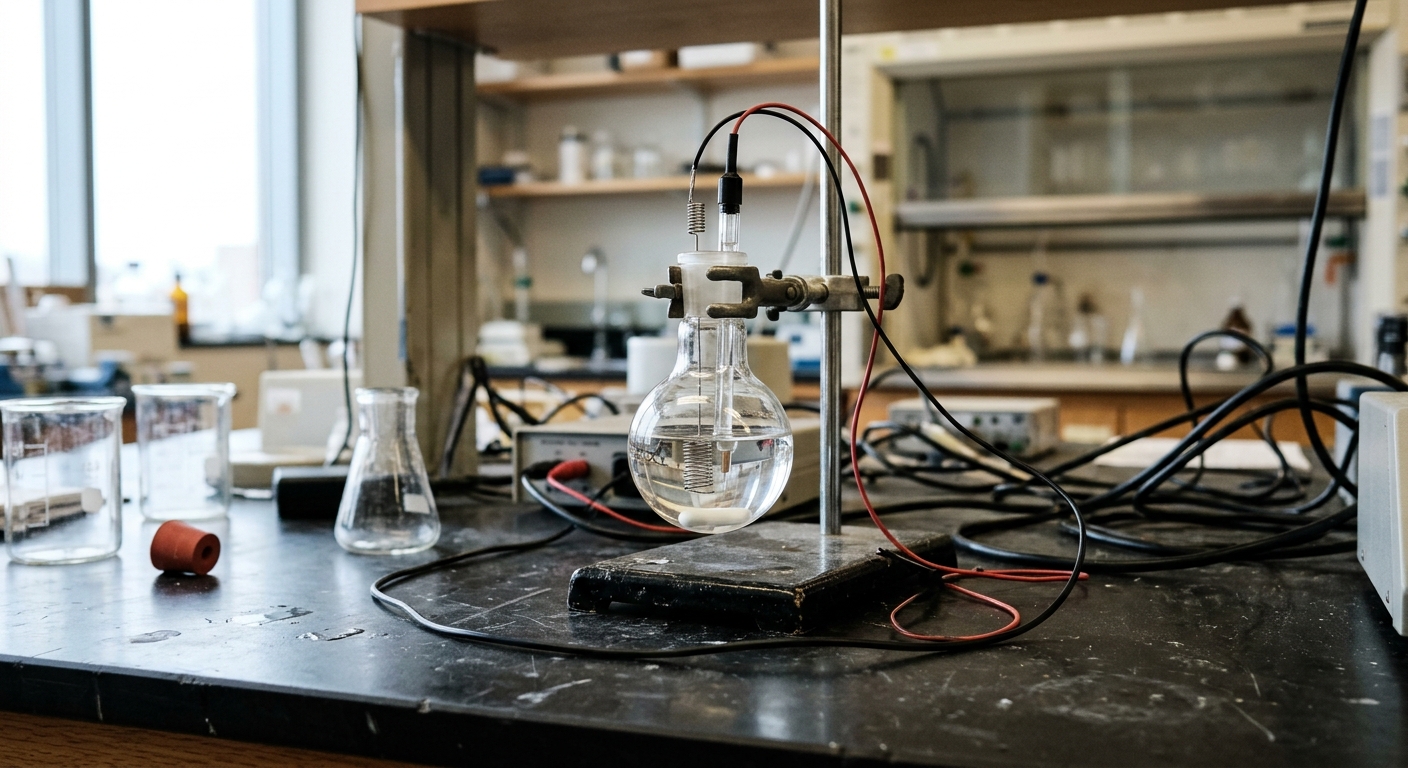
AI-generated illustration; not a photograph of the reported event.
- calendar_today November 3, 2026
New Findings on Methanol Manufacturing Efficiency
Researchers from The Ohio State University have discovered that increasing the power applied to electricity-driven chemical reactions does not automatically enhance their efficiency. This insight comes from a study focused on converting carbon monoxide into methanol—a crucial fuel source and industrial ingredient. The research provides deeper understanding into the underlying factors influencing the reaction, offering a path toward more sustainable chemical manufacturing.
Limits of Power and the Role of Catalyst Binding
The team, led by lead author Zhihao Cui, a postdoctoral scholar in chemistry at Ohio State, found that the success of transforming carbon monoxide into methanol is dictated not only by applied voltage but also by how effectively a catalyst binds to carbon monoxide molecules. The findings highlight that both the binding strength of the catalyst and its chemical environment are essential in controlling the speed and outcome of the reaction.
Innovative Use of Metal Catalysts and Carbon Nanotubes
In pursuit of a more sustainable approach to chemical production, the researchers attached a metal-based catalyst to carbon nanotubes—minuscule tubes of graphene notable for their unique electrical qualities—and introduced carbon monoxide. They experimented by applying various voltages, discovering that a cobalt-based catalyst offers a stronger hold on the carbon monoxide molecules than other metal catalysts tested. This increased retention plays a significant role in the efficiency of the conversion process, particularly at higher voltages, where the speed at which carbon monoxide binds to the catalyst becomes the primary limiting factor.
Electrolytes, Environmental Factors, and Fuel Production
The study also demonstrated that environmental factors, such as surrounding electrolytes and how quickly the environment can reorganize to accommodate new molecules, significantly influence the chemical reaction. At low voltages, the pace is determined by the rate of electron transfer, but at high voltages, the process is controlled by how rapidly carbon monoxide attaches to the catalyst. Both constraints can hinder the overall efficiency of methanol production.
Broader Implications for Sustainable Chemical Production
Co-author Anne Co, a professor in chemistry and biochemistry at Ohio State, emphasized the sustainability potential of these findings. By efficiently converting carbon monoxide—originally derived from carbon dioxide—into methanol, the process could help divert greenhouse gases from being released into the atmosphere. Co noted that refining the steps behind electrochemical reactions paves the way for safer, cleaner industrial processes and increased adoption of renewable electricity sources.
Future Directions in Chemical Manufacturing Research
The team plans to extend their research to other chemical processes, assess system performance over longer durations, and benchmark their methods against conventional approaches. Their work, supported by the U.S. National Science Foundation and Ohio State’s Department of Chemistry and Biochemistry, sets a foundation for next-generation catalysts and electrochemical systems vital for fuel and chemical production. Alina Mary Varghese of Ohio State also contributed as a co-author.
Related coverage
Source: news.osu.edu.