- calendar_today August 10, 2025
A close call for the Museum of Jurassic Technology
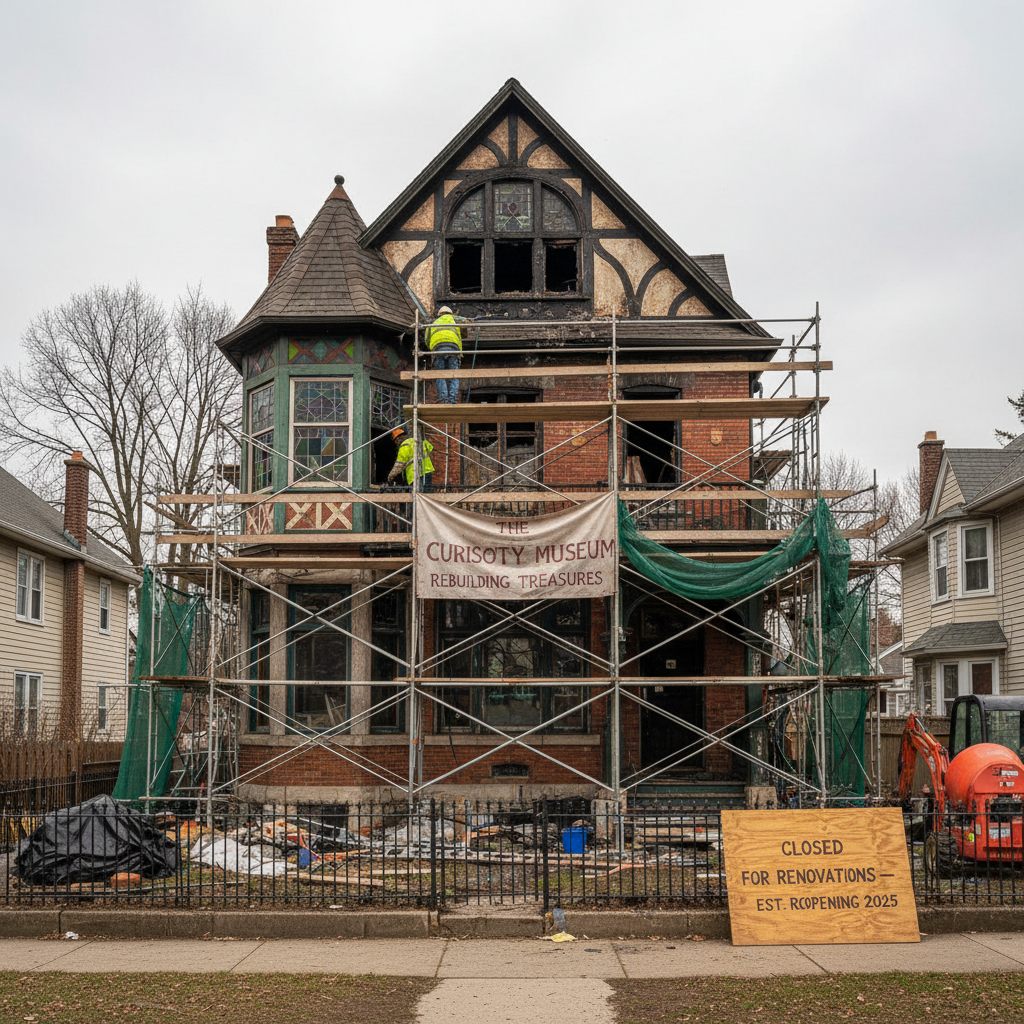
An act of nature in the form of a massive blaze has left one of LA’s weirdest institutions badly scarred, as the Museum of Jurassic Technology (MJT) suffered heavy damage after a fire in the building late last month. The July 8th blaze engulfed the museum’s gift shop and brought with it smoke damage that affected the entirety of the building. Projected losses during the museum’s closure come to about $75,000, though MJT plans to reopen at some point next month.
Fire and Smoke Damage
An oft-overlooked but well-loved part of LA’s cultural landscape, the Museum of Jurassic Technology is strange in Culver City. Curated in a decidedly bizarre and off-kilter way by David Hildebrand Wilson and Diana Drake Wilson since its opening in 1988, the MJT is known for its confoundingly arcane and often disinformation-laden exhibits. A not-for-profit museum in the city of Los Angeles’ historic core, MJT calls itself “dedicated to the advancement of knowledge and the public appreciation of the Lower Jurassic.” In reality, the museum has next to nothing to do with that geologic period or any time period. The MJT is instead a continuation of a tradition established during the Renaissance: wunderkammers, or cabinets of curiosity, early modern ancestors of the institution we know today as the museum.
Storytelling Traditions
Years before the opening of the Museum of Jurassic Technology, Los Angeles cultural figures such as Bob Baker and the Brothers Quay had made their names and followings in LA with an interest in storytelling that employed a similar layering of fact and fiction, or conjured a half-real reality in surprising ways. In the early years of the MJT, for example, these stories had exhibits about both Athanasius Kircher, a real 17th-century Jesuit priest and polymath whose interests were truly encyclopedic, and Hagop Sandaldjian, a real-life Armenian sculptor from the mid-20th century known for his sculptures so small they fit into the eye of a needle and were sculpted from a single human hair.
Subsequent exhibits have built on that tradition with even more challenging questions of authenticity. In one room, real decomposing dice owned by the well-known magician Ricky Jay are on display; in “The Garden of Eden on Wheels,” visitors to the museum are treated to an eminently visual study of Los Angeles-area trailer parks. Elsewhere are stereographic radiographs of flowers, microscopic mosaics made of butterfly wing scales, and an outlandish collection of letters from amateur astronomers to the Mount Wilson Observatory written between 1915 and 1935. Since 2005, the museum has featured a Russian tea room modeled on Tsar Nicholas II’s study in the Winter Palace in St. Petersburg.
Cause of Fire
In a comprehensive account of the fire from author Lawrence Weschler (whose book Mr. Wilson’s Cabinet of Wonder, published in 1996, delved deep into the origins of MJT’s wares), Wilson noticed flames coming from the museum and dashed outside with two fire extinguishers to battle the blaze in the early morning hours. “It was like a ferocious column of flame,” Wilson later told Weschler, recalling how the fire had climbed up the corner wall that faces the street.
Wilson’s fire extinguishers were no match for the flame’s progression, however, and he was fortunately joined by his daughter and son-in-law only moments later, who had brought a larger extinguisher that was able to bring the fire to heel just in time. Firefighters arrived a few minutes later and estimated to Wilson that if they’d arrived only a minute later, they would have lost the whole building.
Smoke damage to the interior was mostly confined to the gift shop, but spread throughout the museum nonetheless. Wilson likened the damage to “a thin creamy brown liquid… evenly poured over all the surfaces—the walls, the vitrines, the ceiling, the carpets, and eyepieces, everything.” Smoke infiltration at this level can be devastating, of course, but for a place that prides itself on its attention to detail and the precision of presentation, the damage was especially noteworthy. Volunteers and museum staff have since labored to clean and restore all of the smoke-damaged surfaces, an ongoing process described as very slow.
Appeals for Support
Weschler’s report was rounded out with an appeal to the museum’s general fund to “help tide it over and back into balance,” because, as he describes it, the MJT is “one of the most truly sublime institutions in the country, a singular monument to intuition and whimsy.” It’s a place that simply can’t be summed up or pigeonhole as one of this or that: it is irreducibly, and charmingly, its creation.
MJT plans to re-open in late August, though the date has not yet been set in stone. As visitors will see when it does return, the same irrepressible force that binds the museum together in its offbeat cohesion will be just as evident in its plans.